Visiting Hours: Summer 2025
Starting in May we will be open on Fridays from 10:00am to 5:00pm (last entry at 4:00pm).
We are also open to the public by appointment.
Parking and entrance are in rear of building on Chapel Ave.
Recently Added Items
1961 EF-140 Analog Kit
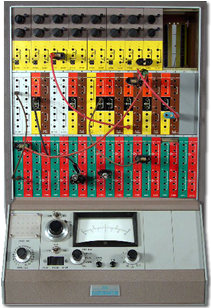
1967 MAC-1 Analog
EAI 1000x
SEARCH THE COLLECTION
We are just starting out on what we hope will be a long journey of discovery. Only 8% of the computers
in our collection and 3% of the documents have been entered into our database. If you have an interest
in research and writing...give us a call at 610-388-5856 and volunteer or write us at volunteers@TheComputerChurch.org.
We will have abbreviated hours on Friday, July 25th. We will be open from 10:00am to 3:00pm. (last entry at 2:30)
Make plans to visit us in Parkesburg, PA
COMPUTER COLLECTION
1922--1985
(Analogs are in green. Mechanials are in blue.)
Only a few are published, you can link to them by using the "decade" search box above. We will link the names in the list below when we get more volunteers.
- Acorn BBC Micro Model B
- Acorn Electron
- AIM-65 (single board)
- AIM-65 (factory case)
- AIM-65 (built by Jon Titus)
- ALICE micro-ordinateur
- Altair 680
- Altair 8800
- Altair 8800A
- Altair 8800b
- Altair 8800b Turnkey (see Pertec below)
- Altair 8800b (see Pertec below)
- Altair 8800b w/ Hardisk Controller & Datakeeper
- Altos ACS-8000
- American Basic Science Club Analog Computer
- American Basic Science Club Analog Computer (later model)
- AMF Educational Computer Model 665/C
- AMF Educational Computer Model 775 A
- Apple II Plus
- ASCI SystemX
- ASR 33 Teletype
- Analog Training Computer ATC-610 (EAI)
- Automatic Teaching Computer Kit
- Beckman ElectroComp Electric Heating Computer
- Beckman ElectroComp Energy Savings Computer
- Beckman Solid State Fuel Cost Computer
- Black Box by Rair
- Brainiac K-30
- Calif. Computer Systems 2200
- CES Ed-Lab 650
- Comdyna GP-6
- Comdyna GP-10
- Commodore 8032
- Commodore 64
- Commodore PET 2001
- Commodore Super Pet
- Compucolor II
- Compukit 1
- Compukit 1 Deluxe Model
- Compukit 2
- Comspace CT-650
- Cosmac Elf (RCA1802)
- Cosmac Microtutor
- Cosmac Netronics ELF II
- Cosmac VIP
- CREI 680
- Cromemco System I
- Cromemco System III
- Cromemco Z-2D
- Datapoint 1800
- Datapoint 2200
- Digi-Comp I (small flat box)
- Digi-Comp I (large flat box)
- Digi-Comp I (long box)
- Digi-Comp II
- Digital Computer Lab
- Donner 3000
- Donner 3500 (See Systron-Donner below)
- DowAlert Stock Computer
- Dynabyte
- E & L Inst MMD-1
- E & L Inst MMD-2
- Eagle II
- Electric Tabulating Machine (one original counter, 1889)
- Electro Scientific Industries Algebraic Computer (ESIAC) Model 10
- Electron
- Electronic Associates Model TR-10
- Electronic Associates Model TR-10
- Electronic Associates Model TR-10 II
- Electronic Associates Model TR-20
- Electronic Associates Model TR-20
- Electronic Associates Model TR-20
- Electronic Associates Model TR-48
- Electronic Associates Model TR-48
- Electronic Associates Model TR-48
- Electronic Associates Model 180
- Electronic Associates Model 380 Hybrid
- Electronic Associates Model 1000
- F-85 by Durango
- FutureTec 180
- Gakken FX-Computer
- General Electric Educational Projects: Analog Computer
- Geniac
- Google Glass White (definitely not vintage)
- Google Glass Blue (definitely not vintage)
- Google Glass Gray (definitely not vintage)
- Heath EC-1 (factory assembled by Heath)
- Heathkit EC-1 (kit)
- Heathkit EC-1 (kit)
- Heathkit ES-400 (kit)
- Heathkit ET 3100 trainer
- Heathkit H8, H9 Video Terminal, H10 Paper Reader, H17 Floppy Drive
- Heathkit Hero 1 (robot)
- Heathkit Hero Jr. (robot with remote)
- Heathkit Hero Jr. (robot)
- Heathkit Hero 2000 (robot)
- Hewlett Packard 2115A
- Hewlett Packard 85
- Hewlett Packard 5036A
- Hewlett Packard 9825A
- Hewlett Packard 9825B
- Hewlett Packard 9826
- Hewlett Packard 9830A
- Hickok Logic Teaching Sys.
- Hickok Servo Teaching Sys.
- I-COR MAC-1
- Iasis 7301
- IBM System 370 (front panel only)
- IBM 5110 PC
- IBM 5120 PC
- IBM 5150 PC
- ICS Microcomputer Training System
- IMSAI 108 (prototype)
- IMSAI 8048 Control Computer
- IMSAI 8048 (The Dollhouse Computer)
- IMSAI 8080
- IMSAI PCS-40
- IMSAI PCS-80
- IMSAI VDP-80
- Informer
- Intel Intellec MDS
- Intel MDS-800
- Intel Prompt 48
- Intel SBC 80/10
- Intel SDK-85
- Intel SDK-85 (unassembled)
- Intel SDK-86
- Interact Model One
- Intertec Superbrain
- ISEC 250 Model A
- ISEC 250 Model B
- ITT MP-EX
- JR-01 Computer
- KIM-1
- LAN-DEC
- LAN-DEC 20
- LAN-ALOG
- LAN-ALOG (modified)
- Lehrcomputer (Germany)
- Lawrence Livermore Lab
- Lear Siegler ADM3A
- Logikit LK255 (Feedback)
- Logix SF-5000 Electronic Computer
- MAC-1 Mini Analog Computer
- MAC Tutor (Bell Laboratories)
- Mark 1A Electro-Mechanical Computer, U.S. Navy, ~1945
- Mark VI Mechanical Computer, U.S. Navy, ~1922
- Mark VII Electro-Mechanical Computer, U.S. Navy, 1937
- Mark 29 Model 1 Gun Sight Electro-Mechanical Computer, U.S. Navy, 1944
- MEK6800D2
- Micro 68
- MicroAce
- Microtan 65
- Microwriter
- Midwest Scientific Instruments 6800
- Minitel
- Minivac 601
- Minivac 601 clone
- Minivac 6010
- Mini-Scamp Microcomputer
- Nascom I
- Nascom II
- National Radio Institute 832
- National Semiconductor Corportation SC/MP
- NEC TK-80
- NeXt Cube Computer
- NorthStar Horizon
- Olivetti Programma 101
- Olivetti Programma 203
- Olivetti Programma 602
- Olivetti M15
- Olson 8080 (Byt-8 Adaptation)
- Open University PT501
- Ordinateur d'Apprentissage JR-01
- Osborne 1
- OSI 300
- OSI 600 (SuperBoard II)
- OSI C2-OEM-4
- OSI Challenger-1P
- Outpost II
- Pastoriza Personal Analogue Computer
- Pertec MITS 300/25 (Altair desk business system)
- Pertec MITS 300/55 (Altair Turnkey business system)
- PolyMorphic Systems 8810
- PolyMorphic Systems 8813
- PolyMorphic Poly-88
- Protech-83
- QDP-100 Quasar Data Products
- QT Systems MF+MD 12
- Realtron Personal Computer Terminal
- Sargent-Welch Scientific Company Cat. No.7528 Analog Computer
- Science of Cambridge MK-14 (Sinclair)
- SD Systems Z80 starter kit
- Sharp MZ-40K
- Sharp MZ-80k
- Siemens ECB-85
- Signetics Instructor 50
- Sinclair ZX-81
- Smoke Signal Broadcasting
- Sol-20
- Spark16
- Sphere 1
- Sphere/SWTPC Computer System
- SWTP CMOS Microlab
- SWTP CT-82 Terminal
- SWTPC 6800
- SWTPC 6800 (w/ Smoke Signal Broadcasting drive)
- SWTPC CT-64 Video Terminal, SS-50
- SWTPC TV Typewriter II CT-1024
- Synertek VIM-1
- Synertek SYM-1
- Systron-Donner 3500
- Tei MCS-112
- Tektronix 4006-1
- Telefunken RAT 700
- TeleSensory TeleBraille II
- TeleSensory VersaBraille P2C
- TeleVideo TS-1605
- Teller Machine Series 6000
- Thoroughbred Horse Race Analyzer
- TI LCM-1001 (Microprogrammer)
- TI LCM-1001 (Microprogrammer)
- TI Silent 700 Terminal
- TI TM 990/189
- Timex Sinclair 1500
- UK-101 by Compukit
- Vector 1
- Vector 3 (VIP)
- Vector MZ
- Viatron System 21
- Vidac 336
- Vydek 1400
- Wang 2200
- Wang PC
- Welch Scientific Company Cat. No.7528 Analog Computer
- Xerox 820 Mark I
- Xerox 1810
- Ymazaki YPC-1000 Basic-alpha
- Zuse Z-23 (selected boards)
OTHER COMPUTERS (LUGGABLES 1982-1986)
- Chameleon Plus
- Commodore SX64
- Datavue Model 25
- Epson HX-20
- Hewlett Packard 110
- Hyperion
- Interview Comstate
- Kaypro 1
- Kaypro II
- Kaypro 2
- Kaypro 2x
- Kaypro 4
- Kaypro 10
- Kaypro 16
- OLPC XO
- Osborne 1
- Panasonic Senior Partner
- Toshiba 3200T
- Visual Commuter
- Zenith ZP-150
- Zorba
RARE & NOTABLE DOCUMENTS
- Hamburgisches Magazin (1747, Description of Vaucanson's Flute Player)
- Babbage's Calculating Engine (1834)
- Electric Tabulating Machine (1889, Herman Hollerith's personal copy)
- The Hollerith Electric Tabulating System (1890)
- Counting a Nation by Electricity (1891)
- Calculating Machines (1947)
- Moore School Lectures Vol. II (1947)
- Mathematical Theory of Communication (1948)
- Communication Theory of Secrecy Systems (1949)
- Collection of books from Claude Shannon's personal library (1940s)
- The "Moore's Law" article (Electronics, 1965)
- Printout from Babbage's Difference Engine #2 (London Science Museum, 2004)
|
Volunteers
Thanks to Colleen, Carol and Austin who helped out putting together IKEA shelving, setting up a new display, moving items around, and sweeping.
Thanks to Carol and Greg for moving things around and getting organized.
Thanks to Pat and Stephanie for wonderful landscaping in the back; mulching and chopping and weeding and other outdoor stuff.
Pennsylvania Computer & Technology Museum is proud to display the one of the world's largest collections of vintage computers.
The "EarlyComputers Collection" spans the first 150 years of computing...from the 1830's to the 1980's and contains over 200 personal
computers along with hundreds of vintage books, magazines and rare documents. The collection also contains over 35 Analog Computers,
a type of computer that pre-dates our digital age.
We are currently preparing The Computer Church to display
some of the most interesting items in the collection. We are also in the process of
setting up a Research Library and we are continuing to work on adding new information to this website.
VOLUNTEERS
We are looking for volunteers to work with us in creating displays, developing educational materials, doing conservation work on the computers,
helping with general maintenance of the building, conducting research, and the list goes on. If you have any interest in volunteering, please either email us at
volunteers@TheComputerChurch.org or call us at 610-388-5856.
In addition to extensive pictures, we will, whenever possible, try to place
each computer within the larger context of technology, culture, economics and aesthetics...to give
you the personal story.